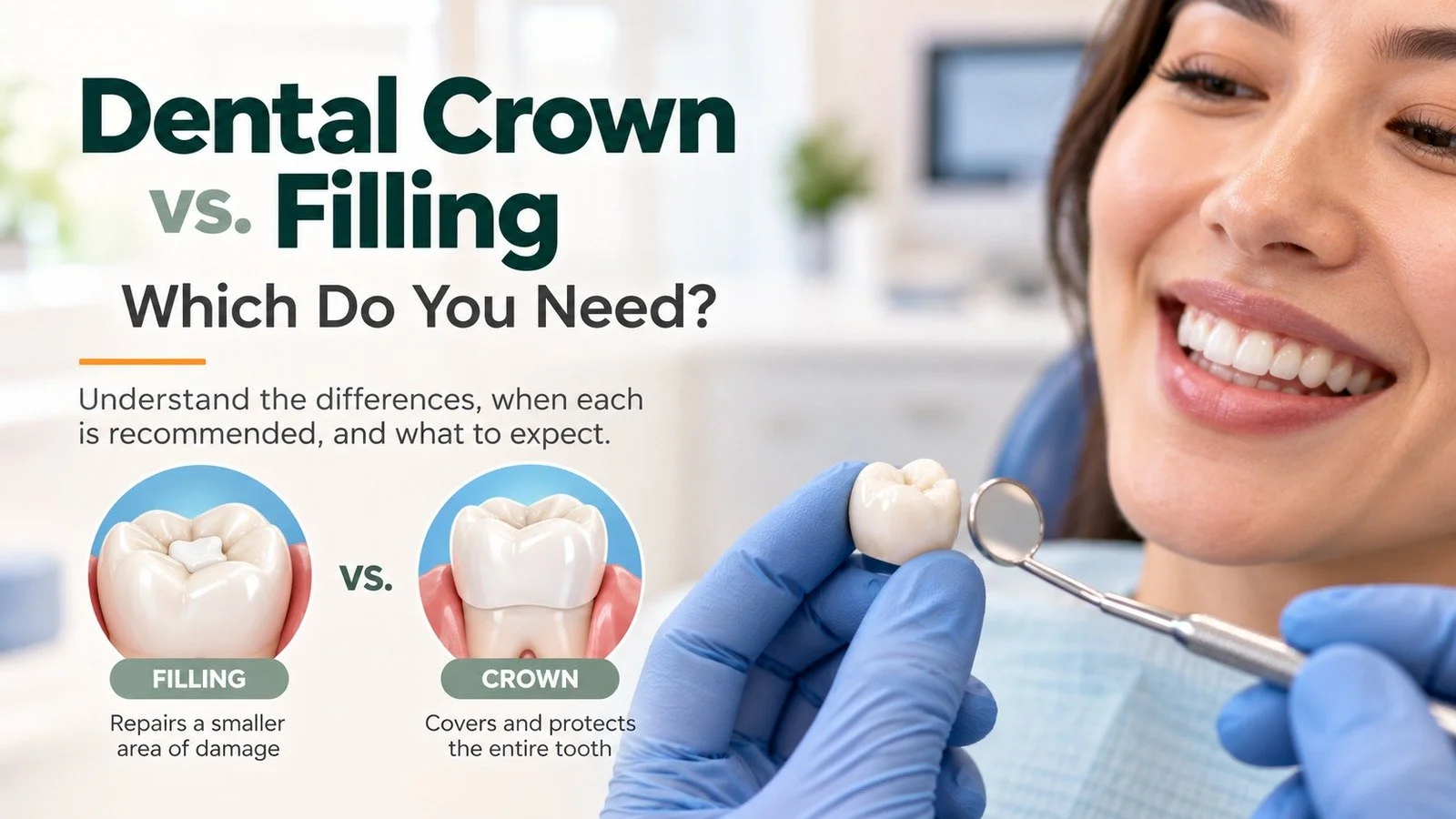
You've just visited the dentist and learned that one of your teeth needs treatment. But instead of a simple filling, your dentist recommends a crown. You might wonder: Why can't I just get a filling? Is a crown really necessary?
At Stoneridge Dental in Pleasanton, we believe patients should understand their treatment options before making a decision. Here's what you should know about dental crowns and fillings, including when each is recommended.
What Is a Dental Filling?
A dental filling is one of the most common restorative treatments. It's used to repair a tooth affected by a cavity, minor fracture, or other localized damage. During treatment, the dentist removes decayed or damaged tooth structure and replaces it with restorative material. Tooth-colored composite fillings can blend naturally with your smile.
When Is a Filling Recommended?
- The cavity is relatively small or moderate in size.
- Most of the natural tooth structure remains healthy.
- The tooth has enough strength to withstand chewing forces.
- The damage has not significantly weakened the tooth's cusps or walls.
The main advantage of a filling is that it generally preserves more natural tooth structure than a crown. Most fillings can be completed in one visit. However, when damage is extensive, an oversized filling may not adequately protect the remaining tooth.
What Is a Dental Crown?
A dental crown is a custom-made restoration that covers the visible portion of a tooth above the gumline. Unlike a filling, which repairs a specific area, a crown surrounds the tooth to restore its shape, appearance, and function. Modern crowns can be made from zirconia, lithium disilicate, or other ceramics, offering strength and natural-looking aesthetics.
When Is a Crown Recommended?
- A large cavity has weakened the tooth.
- An existing filling occupies a significant portion of the tooth.
- The tooth has fractured or has weakened cusps.
- A tooth treated with root canal therapy needs additional protection.
- The tooth is severely worn or structurally compromised.
Imagine a molar with a large filling that covers much of its chewing surface. Over time, the remaining tooth walls may be vulnerable to cracking under chewing pressure. A crown may help protect the remaining tooth by covering and supporting its structure.
A crown isn't automatically necessary just because a filling is large or a tooth has had root canal treatment. The recommendation depends on the amount of remaining tooth structure, tooth location, bite forces, and clinical findings.
Dental Crown vs. Filling: Key Differences
- Coverage: A filling repairs part of the tooth; a crown covers the tooth.
- Tooth preparation: Fillings usually require less preparation than crowns.
- Time: Fillings are typically completed in one appointment; crowns may require one or more.
- Cost: Fillings are generally less expensive than crowns.
- Longevity: Both can last many years, depending on their size, material, location, and care.
Why Not Always Choose a Filling?
It's natural to prefer the simpler and less expensive option. However, a large filling doesn't necessarily reinforce weakened tooth walls. Under repeated chewing forces, those walls may fracture. If a fracture extends deeply below the gumline or into the root, the tooth can become difficult or impossible to restore.
That's why your dentist evaluates more than the size of a cavity. We consider the amount of healthy tooth remaining, existing cracks, bite forces, and the tooth's long-term prognosis. The goal isn't simply to repair today's damage but to choose a restoration likely to function well for years.
Is There an Option Between a Filling and a Crown?
Yes. In certain situations, a dental inlay or onlay may be an alternative. An inlay fits within the chewing surface of a tooth, while an onlay extends over one or more cusps. For some moderately damaged teeth, an onlay can provide additional protection while preserving more natural tooth structure than a full crown. Not every tooth is a suitable candidate, but it's worth discussing when appropriate.
Does Getting a Crown Hurt?
Crown procedures are typically performed using local anesthesia to keep you comfortable. The dentist prepares the tooth, takes an impression or digital scan, and fits a custom restoration. Depending on the restoration and workflow, treatment may require one or more visits. Some temporary sensitivity or gum soreness can occur afterward, but significant or persistent pain should be evaluated.
How Long Do Fillings and Crowns Last?
There's no universal expiration date for dental restorations. Longevity depends on the restoration's size and location, the material used, oral hygiene, grinding or clenching, diet, and regular dental examinations. A small filling may last many years, while a large filling on a heavily loaded molar may need replacement sooner.
Similarly, a well-maintained crown can provide many years of service, but it isn't immune to fracture, wear, or recurrent decay around its margins. Brushing twice daily with fluoride toothpaste, cleaning between your teeth, and attending regular dental visits can help protect your restorations.
How Much Does a Crown Cost Compared to a Filling?
Crowns generally cost more than fillings because they involve additional materials, fabrication, and more extensive treatment. Your actual cost depends on the tooth, restoration type, complexity, and dental insurance benefits. Some plans cover part of crown treatment when it meets their criteria, but coverage varies. At Stoneridge Dental, we explain options and provide estimates before proceeding.
How Do You Know Which Treatment Is Right for You?
The best way to determine whether you need a filling, onlay, or crown is through a clinical examination. Your dentist may use X-rays, visual examination, and other diagnostic tests. Sometimes a small cavity can be treated conservatively with a filling. Other times, a tooth that looks normal from the outside may have cracks or a large existing restoration requiring more protection.
The best treatment preserves as much healthy tooth structure as reasonably possible while providing a durable, predictable restoration.
Looking for Dental Crowns or Fillings in Pleasanton?
At Stoneridge Dental, Dr. Nelson Wong provides personalized restorative dental care for patients in Pleasanton, Dublin, San Ramon, and surrounding Tri-Valley communities. Whether you have a new cavity, a broken tooth, or an old filling that needs replacement, we'll explain your options and help you choose a treatment that makes sense for your dental health.
Schedule your appointment with Stoneridge Dental today. Call (925) 830-8989 or visit www.stoneridgedds.com. Find us at 4487 Stoneridge Dr, Suite 102, Pleasanton, CA 94588.
This article is intended for general patient education and does not replace an individualized dental examination.