If your dentist recommends removing a tooth, you may hear another term during the conversation: bone grafting. It can sound intimidating, especially when you were only expecting an extraction. But a bone graft is often a straightforward way to preserve the shape of your jaw and keep future tooth-replacement options open.
At Stoneridge Dental in Pleasanton, we want you to understand not only what a procedure involves, but why it may be recommended. Here is a practical guide to bone grafting after tooth removal, including healing, discomfort, and dental implant planning.
What Happens to Your Jawbone When a Tooth Is Removed?
Natural tooth roots help maintain the surrounding jawbone through the forces of everyday chewing. After a tooth is extracted, that stimulation disappears. The bone around the empty socket begins to remodel, and the ridge can gradually become narrower and shorter.
Some changes happen during the first several months, although the amount varies considerably from person to person. The location of the tooth, the condition of the socket walls, gum health, and the reason for extraction all influence how much bone is lost.
Bone loss after extraction is normal biology, not a sign that something went wrong. However, it can make future implant placement or other restorative treatment more challenging.
What Is a Dental Bone Graft?
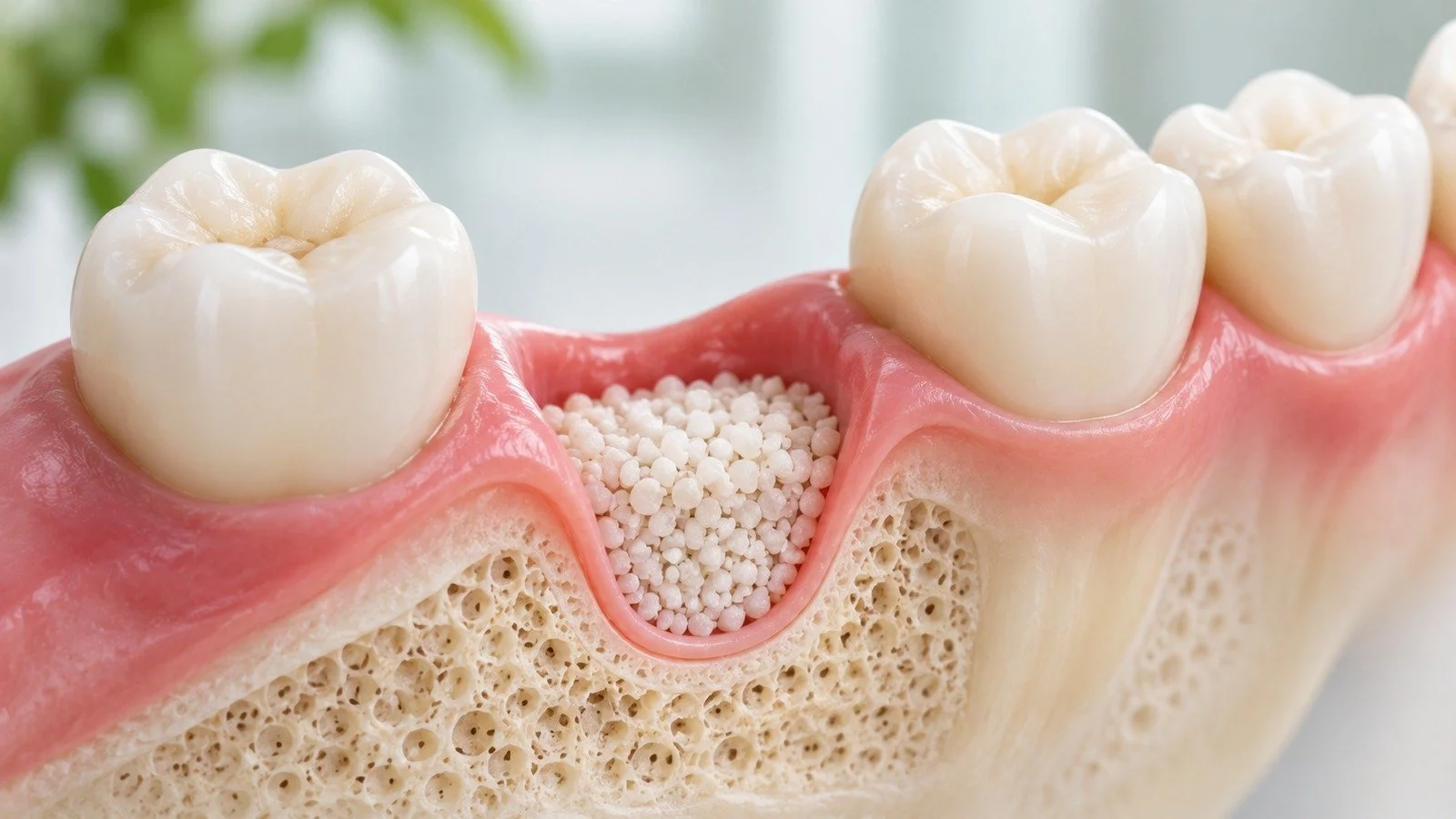
A dental bone graft places a biocompatible material in an area where additional bone support is needed. After an extraction, the procedure is often called socket preservation or ridge preservation.
The graft material acts as a scaffold while your body heals and forms new bone. Depending on the case, your dentist may place a protective membrane over the material and close or stabilize the site with sutures.
Grafting materials may come from processed human donor bone, animal-derived sources, synthetic materials, or occasionally your own bone. Each has different characteristics. Your dentist should explain which material is recommended and why.
Why Might Your Dentist Recommend a Graft?
1. To preserve the ridge for a future implant. Dental implants need sufficient healthy bone for support. Preserving the extraction site may reduce the amount of additional grafting needed later, although it cannot guarantee that an implant will be possible without further treatment.
2. To maintain the contour of the gums and jaw. The bone beneath your gums helps support their shape. This can be particularly important in visible areas of the smile, where changes in the ridge may affect the appearance of a future restoration.
3. To address existing bone defects. Infection, periodontal disease, or a fractured tooth may leave part of the socket wall damaged. Certain defects benefit from grafting, while others require a more involved approach.
4. To keep treatment options open. Even if you have not decided between an implant, bridge, or removable partial denture, preserving the ridge may offer advantages for future planning.
Does Every Extraction Need a Bone Graft?
No. Bone grafting is not automatically necessary after every extraction. Some sockets heal adequately without a graft, and in certain situations grafting may offer limited benefit. For example, your dentist will consider whether the tooth will be replaced, the location of the site, existing bone anatomy, infection, medical history, and your goals.
If a wisdom tooth is removed and no replacement is planned, socket preservation is often unnecessary. On the other hand, grafting may be worth discussing when a molar or front tooth is removed and an implant is being considered.
Sometimes a dentist can place an implant immediately after extraction; other times it is safer to allow healing first. An immediate implant does not always eliminate the need for grafting.
What Happens During Socket Preservation?
The procedure is commonly performed during the same appointment as the extraction. After the tooth is removed, the dentist cleans and evaluates the socket. If grafting is appropriate, the material is placed into the site. A membrane, collagen dressing, and/or stitches may be used to protect and stabilize the area.
Local anesthesia is used to keep you comfortable. You may feel pressure or movement during treatment, but sharp pain should be reported immediately so additional anesthesia can be provided.
Before you leave, you will receive instructions on managing bleeding, eating, brushing, and protecting the surgical area. Your dentist may also schedule a follow-up to check healing.
What Is Recovery Like?
Mild soreness, swelling, and small amounts of bleeding or oozing are common during the first few days. Your dentist may recommend over-the-counter pain relief when medically appropriate or prescribe medication based on your needs.
To help protect the site:
- Follow the specific written instructions provided after surgery.
- Avoid smoking or vaping, which can interfere with healing.
- Do not disturb the socket with your tongue, fingers, or vigorous rinsing.
- Choose softer foods initially and chew on the opposite side when possible.
- Keep the rest of your mouth clean, but be gentle around the surgical area.
- Attend follow-up appointments and take medications only as directed.
Occasionally, tiny graft particles may appear in your mouth during early healing. A few loose granules do not always mean the graft has failed. Contact your dental office if you notice substantial material loss, worsening pain, persistent bleeding, fever, pus, or increasing swelling. Trouble breathing or swallowing requires emergency medical attention.
How Long Before You Can Get a Dental Implant?
Soft tissues generally improve much sooner than the underlying bone matures. After socket preservation, dentists often reassess the site after roughly three to six months, although some cases require a longer wait. Timing depends on the size of the defect, graft material, healing response, and proposed implant position.
Before implant placement, your dentist may use X-rays or a three-dimensional CBCT scan to evaluate available bone and nearby anatomical structures. A graft improves the potential foundation, but the final decision is based on how the site actually heals.
Is a Bone Graft Worth It?
The answer depends on your long-term plan. Grafting adds cost and a healing step, and it does not prevent all bone shrinkage. It also carries potential complications, including infection, graft exposure, or incomplete healing. Nevertheless, for selected patients, preserving the ridge at the time of extraction can be less involved than rebuilding a severely resorbed ridge months or years later.
Ask your dentist what is likely to happen without grafting, whether an implant is a realistic goal, and what alternatives are available. A clear explanation should help you make a decision that fits your health, priorities, and budget.
Planning a Tooth Extraction or Dental Implant in Pleasanton?
At Stoneridge Dental, Dr. Nelson Wong helps patients in Pleasanton, Dublin, San Ramon, and the surrounding Tri-Valley understand their options for tooth removal, bone preservation, and replacement. We will evaluate your individual situation and explain whether grafting makes sense for you.
Have questions about a missing or damaged tooth? Call (925) 830-8989 to schedule a consultation at Stoneridge Dental in Pleasanton, CA. You can also explore our dental services and appointment options online.
This article provides general education and is not a substitute for a personalized dental examination or treatment recommendation.